Academic summers always start with a plan. This is the summer I’m going to start three new lines of research, writing key bits of code myself. It’s the summer I publish those two papers I’ve had in draft. It’s the summer I’m going to step away from the screen and finish a dozen pending house projects.
And then reality sets in and it’s August and you’re analyzing the wreckage of those summer plans.
There’s been lovely moments to this summer: a trip to France with Amy to see colleagues and family, some research on Pittsfield MA history with a fantastic intern visiting from the UK, great bike rides with a dear friend. But the dominant narrative of Summer 2026 has been about my eyes.
Long time readers have come to expect a vision-centric post from me every three years or so. The past decade has been blissfully free of vision disasters, but that happy trend ended this summer. The quick summary: I have vision problems associated with type-1 diabetes that have required many surgeries over the years. At a certain point, those surgeries (pars plana vitrectomy to address vitreous hemorrhage) lead to their own problems: cataracts. I’ve had cataract surgeries on both eyes, which replace the clouded natural lens with a synthetic lens. The one on my right eye has been unproblematic – my left eye is another story.
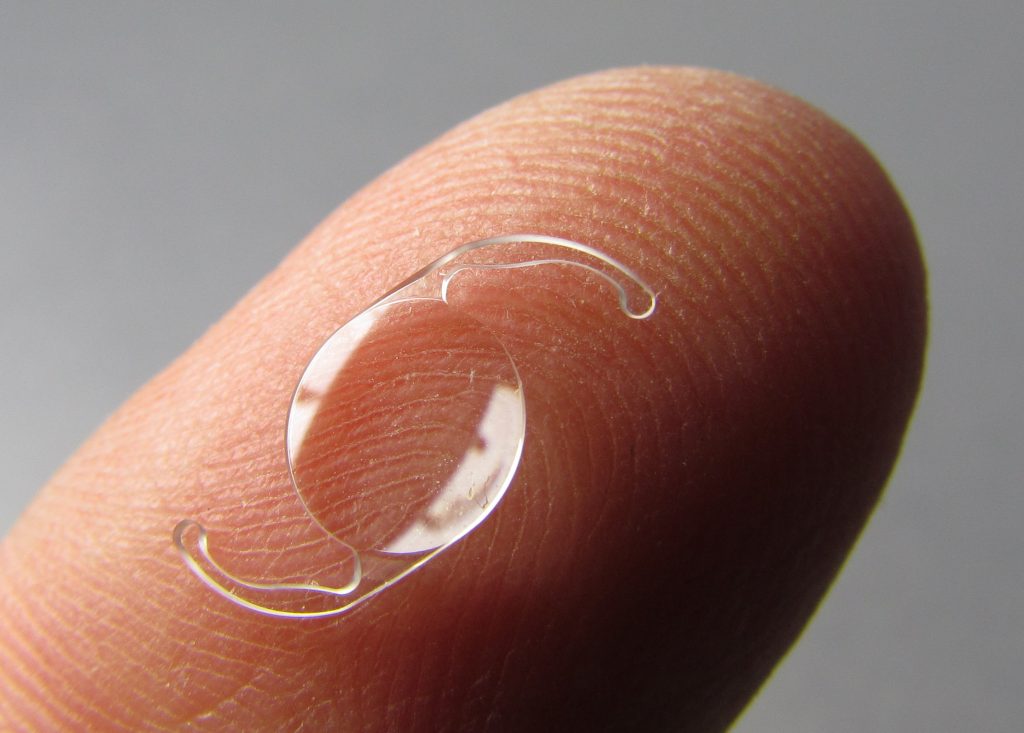
An introocular lens on someone’s finger, which is almost certainly unsanitary
Early this summer, the lens in my left eye came loose. At first, I noticed it only when I was lying in bed on my left side, where the pressure on the head or the angle allowed the lens to come loose. Then one very strange morning, I found myself lying on my back in bed with a truly bizarre floater in my eye. It looks like a translucent flying saucer with two arms, each terminating into a needle’s eye. It’s the intraocular lens that was supposed to replace my natural lens, and one of my favorite activities for the summer has been sketching my alien invader and asking Google Lens to identify what specific model it is.
Gravity being what it is, when I’m standing or seated, the lens – who we’ve named “Sue” after the Dion song “Runaround Sue” – drifts to the bottom of the eyeball, providing no ability to focus, but also staying out of the way. And she’s fun to look at when I am lying on my back. But she’s downright hazardous when I lean down to look at something – she floats to the back of the retina and further confuses the blurry signals I’m getting from that eye. Look down to pick something up off a table or tie a shoe and I find I’m inadvertently squeezing that eye shut to lessen the disorientation.
(For those of you saying, “Ethan, your eyes are filled with vitreous humor – it’s like gelatin, and therefore your lens cannot be floating around the eyeball” – yes, that’s true of your eyes. But I’ve had vitrectomies on both eyes, removing the vitreous humor and replacing it with saline solution, which means my eyes are basically snow globes.)
Here are some things that are relatively comfortable to do: watching TV or movies, driving, interacting with people one on one. Here are some things that I can do for a few hours a day: reading on a screen or phone, where I can adjust text size. Here are things that are possible but exhausting: reading print, interacting with people in a room where people are various different distances away from me, like a conference, meeting or cocktail party. Here’s what’s basically impossible: manual dexterity tasks looking down, any sort of close work involving hand eye coordination.
So, my well-laid plans to complete half a dozen carpentry projects are on hold, for fear of losing fingers. The programming sprint I was planning is on hold because, while I can dictate orders to Claude and pipe responses through voice synthesis, the work I need to do to find patterns in spreadsheets of data to figure out what hypotheses to pursue is impossible. The summer has involved an enormous amount of reading, all accomplished through listening, and a small amount of writing, mostly dictated. And many, many long naps – even a few hours of screen time puts me in a state where I need ten hours of sleep at night and two midday naps.
Three observations from the Summer of Sue:
– Since my eyes go on strike every few years, I’ve had a chance to experience many different generations of assistive technology. The quality of assistive technology has undergone a quantum leap, at least as far as my disabilities are concerned, in the past few years.
After auditioning a bunch of more expensive systems, I’ve centered on paper2audio as my main voice synthesis package. The free version can generate up to 56 hours of audio a week, which is more than enough for me, and the software uses LLMs to remove cruft (footnotes, formatting text), to summarize charts and label images. It’s vastly better than competitors who charge large monthly fees to have a synthetic Scarlett Johansson read academic papers to me. I’ve made it through book manuscripts with this system, dictating my peer review to MacWhisper, an implementation of OpenAI’s Whisper that runs locally on my laptop. (paper2audio sends documents or webpages to a server and returns mp3s to me.)
I’ve used audio synthesis to read to me for more than twenty years now. Up until very recently, it just wasn’t possible to listen to a synthetic voice for more than 15 minutes without getting annoyed or tired. I can tolerate paper2audio for more than 2 hours, which is a massive shift in terms of productivity.
– Once voice synthesis and voice recognition are solved challenges – and they basically are for me with this setup – there’s a new challenge: how do you learn to write in this environment? My writing process involves a ceaseless back and forth between text files filled with outlines and notes, other text files with URLs to articles I found useful, and half a dozen browser windows looking for examples and quotes. I can read, I can write, but the process is utterly unlike how I have written countless blog posts, papers and three books.
I’m writing two ways this summer. Short pieces are getting dictated, sometimes while I drive, in a process where I think really hard about what I want to say for ten minutes and then talk for ten minutes. I repeat those steps as necessary, transcribe the results and edit on the screen. I’ve tried adding in a step of listening to the resulting text before editing, but it doesn’t work well – speech has different rhythms than writing, and you can end up with something that sounds okay but reads oddly. And then, occasionally, I am sitting down at the computer and banging out a piece like this one, stopping to find a hyperlink here and there, writing fast and feeling like there’s a time clock rapidly ticking down before the headache and nausea kick in and force me away from the screen.
I hope I don’t have to face the task of retooling my writing process into one in which dictation and voice synthesis are central, but that may be in my future. I suspect that would require not only new software, but a pretty thorough rewiring of my brain, which is fine at focusing on one thing at a time using my ears, but hasn’t found a good way to synthesize across a wide range of inputs, something my eyes are very good at.
– Like many people who do what they love for a living, I am a workaholic, by which I mean: my sense of self-worth is closely linked to accomplishing tasks. Specifically, my sense of happiness correlates almost linearly to how much good writing I am getting done. Carpentry is sometimes an adequate substitute. And with both off the table, this has been a summer of learning to rest, to appreciate other aspects of my life, to exercise patience and to try to discover self care.
I fucking hate it.
I can appreciate that slowing down is something I’m going to have to do as I age, and I am absolutely supportive of the idea that the world would be a better place if we all realized that the people around us are generally doing their best to navigate obstacles and struggles that we rarely see. But I really like my life most of the time, and a sharp, though temporary, decrease in quality of life is currently kicking my ass.
The good news: this is probably getting significantly better in a bit more than two weeks. I’m having surgery on August 26 which will remove Sue and other cruft from my left eye, introduce a new lens and attach it to the sclera (the white of the eye) with four GoreTex sutures. Just try moving that lens out of position! (Don’t. Seriously, that would be really painful. What the hell is wrong with you?) There will likely be a month or two of adjustment while the swelling from the surgery subsides, but I expect to have much better vision before the fall semester starts, and normal vision before the leaves are off the trees.
And so, this is a plea for patience for anyone waiting for something from me: not only am I doing what I can, I’m probably doing a bit more than I should. And it’s a reminder to future me that there some cognitive benefits to slowing the hell down, even at moments that my body has not gone on strike to force said slowdown. So here’s to the summer of Sue and hopes for a less blurry autumn.
Settle down and let someone else be awesome for a while. You’ve earned it. The awesome… it burns.
So delighted to get to see you for a bit in a circumstance that fits well with current abilities.
I picked up drawing when my arm was broken, and it’s served me well. Adaptive behavior, including learning to rest, helps us be more resilient. ?
Thanks for sharing these reflections. Meaningful and relatable on many levels.
Thank you for sharing your challenging journey. My spouse has been dealing with vision problems due to his Type 2 diabetes. Unfortunately I haven’t learned much about the effects diabetes has on sight apart from rather detached medical discussions. I appreciate your personal perspective greatly as it will help me understand a little better what issues my spouse might experience (he’s not a very good communicator when it comes to health issues, sorry to say).
Wish you a visually beautiful autumn as a result of successful treatment and rapid healing.
Sorry to read this. Agree that the assistive technology has taken mega leaps. I am partially deaf but just got new AI powered hearing aids that distinguish between all sounds and the voices I am trying to hear and converse with. It has been a game changer.
Thanks for sharing, Ethan. I’m glad to read that you’ve got a new lens on the way!
All the very best wishes to you Ethan. I’ve been reading your articles since the mid-00s (20 years? Yikes!) and learning from your insights. Long may you continue once it’s easier again!
Thanks, Sue, for catalysing these reflections. Blame on you for the rest.
Fingers crossed for August 26.
Hugs :)
<3 Thanks for sharing Ethan. I'm glad the assistive tech is proving helpful, and will be rooting for Sue's removal and your subsequent healing!
Thanks for reminding me that this post is here – I read half of it on my phone when you first posted it, then life happened, and I’ve just now returned to it and finished it.
Holding you in prayer for complete healing & best outcomes, as ever.