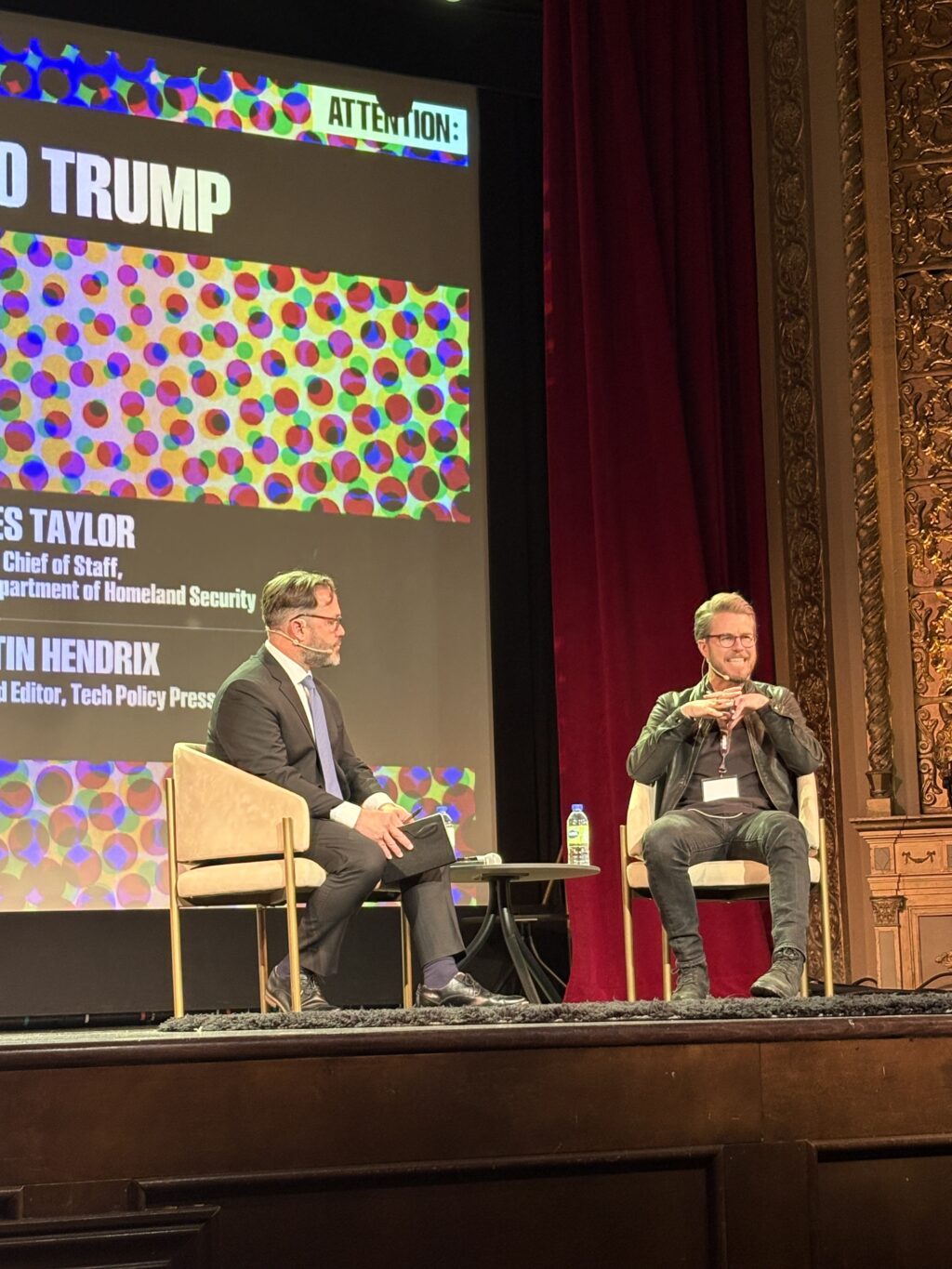
Justin Hendrix of Tech Policy Press asks Miles Taylor, former Chief of Staff of the US Department of Homeland Security, about President Trump’s attacks on him as part of his “revenge tour”. Taylor invites us to take a selfie with him if we’d like a trip to federal prison. He suggests that simply being named in an executive order has been enough to destroy his life and his business. Not only is he facing death threats, but friends and family are worried about being included in the attacks. “The process is the punishment”, he explains. It doesn’t matter if the government loses in federal court, because simply being blacklisted is often enough to ruin your life. Taylor suggests that virtually everyone in the audience has committed at US federal crime – the question is whether the government comes after you.
Taylor is a Republican and served under two Republican administrations. But he wrote an anonymous oped in the New York Times in 2018 titled “I Am Part of the Resistance Inside the Trump Administration”, arguing that there was an “axis of adults” trying to restrict Trump’s worst impulses. The performance of Trump II suggests that he had a point: the unwillingness of some government bureaucrats to not break their oaths of office prevented a great deal of bad behavior.
Taylor wrote a book in 2023 called “Blowback” about what he believed would happen if Trump returned to power. He says roughly 80% of his “made up, sky is falling lies” have already come true in the new administration. Congress has been sidelined and the Article III courts are “a very fragile bulwark” at the moment. He predicts that we will see the administration defy a major decision sometime soon, which means we the people will have to find some way to oppose Trump 2028, which Taylor assures us is his intention.
Hendrix asked Taylor about the post-9/11 creation of the Department of Homeland Security. Taylor explained that he was resistant to the idea that a DHS could be dangerous when he began his career. But those critics were right and he was wrong, he tells us. Better guardrails and civil rights protections should have been in place. “Even the media doesn’t understand how to provide transparency” around DHS – it’s a confusing bureaucratic backwater that’s harder to cover than the Pentagon. “DHS is becoming the pocket police for the President…” and the director of DHS functions as the warden of Trump’s police state.
Because DHS can track terrorist activity, it’s important to note that DHS now considers anti-Christian, anti-capitalist or anti-fascist beliefs to be terrorist aligned. So there are a lot of contexts in which people might find themselves targets of surveillance.
Asked about the insurrection act, Taylor tells us that Trump, behind the scenes, referred to the act as “his magical powers”. When he came into office, he asked lawyers what the ceiling of presidential authority was – they told him that the closest to martial law the US has is the insurrection act. Under the right circumstances, there’s basically no limit to what the President could do. “It could go from mild to wild very quickly” if the Trump team does this. While he was in office, Trump’s staff tried to prevent this from happening. But now, Taylor tells us, Trump is trying to create sufficient violence in cities that he is able to use the act to take on arbitrary powers.
Trump intends to have an unconstitutional third term, Taylor tells us. They will likely run Vance at the top of the ticket and Trump as VP – JD will resign and allow Trump to take over, or he will simply run the White House from the VP office. Alternatively, he could have himself installed as speaker of the House and then seek impeachment of the President and Vice President should he lose the 2028 election.
Asked about tech oligarchy, Taylor tells us that he has grave concerns about how companies are engaging with the administration. “They are, by default, making huge public policy decisions behind the scenes.” He offers the example of Palantir, which is winning many contracts, and is promising to connect various government databases. Those databases are often disconnected for policy reasons that Congress put in place. Without debate or discussion, Palantir is connecting these sets of information in a blitz started by DOGE and continued within IT systems.
MAGA is not a monolith, Hendrix offers – perhaps we will see resistance to AI within the MAGA movement. Taylor notes that Marjorie Taylor Green and Steve Bannon deeply distrust the tech sector. JD Vance has been incredibly successful, he suggests, in bringing the tech companies to heel. The only people who can change this are users and employees, as happened with Disney and Jimmy Kimmel. If Apple employees had stormed out of their HQ when Tim Cook brought a gold-plated gift to Trump, that might have done something. But this administration is for sale, and if you give to the Ballroom, you’re going to get light regulation. Tech company CEOs don’t have spines, the suggests, but their employees do, and they might have the power to make tech companies stand up to Trump.
Right now, Taylor tells us, the price of dissent is extraordinarily high. People tell him that they’re worried to click “like” on posts on social media for fear of being added to a watchlist. The only meaningful way to lower the price of dissent is to increase the supply. That is, he argues, what any of us can do to defend democracy.