Salon, a web magazine founded in 1995, recently announced that it was shutting its doors, saying the “business realities of independent digital journalism have changed profoundly”. They are certainly not the only publication suffering at present. Traffic from Google to journalism websites has dropped to the point where some sites are choosing not to be indexed at all – the cost of making their content accessible to Google’s armies of bots is not worth the tiny amount of revenue Google now drives to their sites. An article from senior figures at Creative Commons and Public Knowledge makes a convincing case that the current economic bargain of the web – professional content supported by ads is indexed by search engines, who support themselves with some advertising while driving traffic to the content creators – just doesn’t work anymore. (I disagree with the arguments that LLM training is “fair use”, and I support some of the legislation the authors oppose, but I found their overview of the field useful.)
It turns out I have a few articles on Salon: an excerpt from my first book, Rewire; an article first published on The Conversation; an article about misinformation in which I am one of three authors. There’s a good chance these articles will become inaccessible as Salon shuts its doors, though lots of content gets stored at the Internet Archive, a project that’s facing its own challenges: some publishers are now blocking the Archive from preserving their work, seeing IA as a “back door” AI bots can abuse to copy their content without licensing it.
As it happens, I started a personal archiving project about a week ago. For years, I’ve been meaning to come up with a better way of maintaining my academic CV and ensuring that I could share copies of articles with fellow scholars. More than anything, the project was an attempt to honor writer Joanna Maciejewska’s idea that AI should do the laundry and the dishes so I could focus on writing and making art. Starting from Google Scholar, Muckrack and a whole bunch of author pages on different websites, I asked Claude to develop a chronological archive of my writing and to create local copies of each article so I could still access my work if and when the sites hosting it go down.
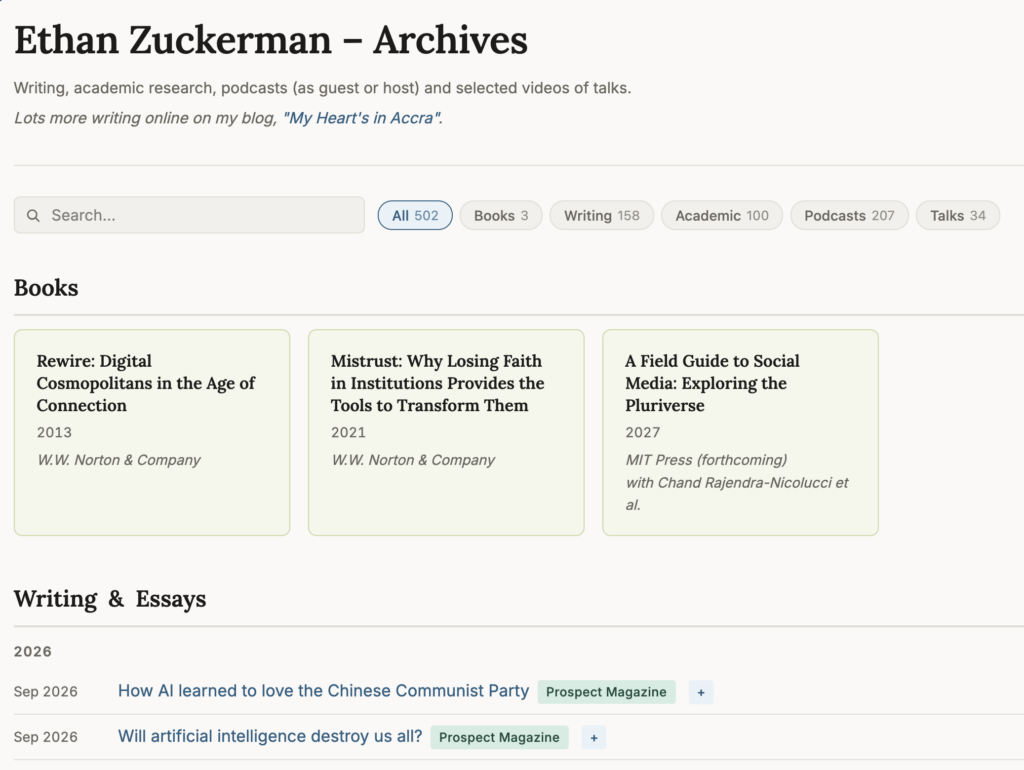
The project took on some other dimensions – it now indexes podcasts that Mike Sugarman and I created for Reimagining the Internet, some podcast appearances I’ve made as indexed by Listen Notes, and a subset of public talks I’ve given that appear on YouTube. This is not a complete archive of my online presence – the vast majority of the posts I’ve made to my blog don’t appear in this archive, just ones that were academically cited and ingested via Google Scholar, or widely linked to the point where Muckrack indexed them.
Seeing a list of a couple hundred articles I’ve authored or co-authored gives me both a warm feeling, and deep anxiety about all the papers I have in review. I guess it’s a good thing that I’m more excited about the work that hasn’t seen the light of day than the stuff that’s already out there? But more importantly, it feels like an insurance policy against the internet’s ongoing erasure.
I learned many years ago that not only is the Internet’s memory limited and brief, but that you don’t know what you’ll miss when it’s gone. I used to reassure myself that while the graphics I designed for the early days of Tripod.com disappeared from the web years ago, they surely existed on old floppy disks in my basement somewhere. As I pack up old boxes for a move to Montreal, I’ve come to accept that I’m not willing to invest the time in getting a circa 1996 Mac online and mounting old zip discs.
But watching Salon disappear puts me in mind of the trees in November: no one can pretend they’re surprised to see the leaves fall. For anyone who’s shared their words, music, art or film online, this is a good time to make sure you’ve got a plan to save your work. For better or worse, you’re the one best positioned to do so.
This is meant mostly as a tool for me, but in case you want to search my back catalog, my archives are here.